Learn how the Net Promoter Score measures customer loyalty, its history, how it works, common criticisms, and the latest developments making NPS more powerful than ever.
The Net Promoter Score (NPS) has become a fundamental metric in market research, enabling organizations to measure customer loyalty through one straightforward question: “How likely are you to recommend our product or service to a friend or colleague?” Respondents answer on a scale of 0 to 10, and the resulting score offers a clear snapshot of customer sentiment.
A Brief History of NPS
Fred Reichheld, a partner at Bain & Company, introduced the Net Promoter Score in a 2003 Harvard Business Review article titled “The One Number You Need to Grow.” His research demonstrated that traditional customer satisfaction surveys were overly complicated and didn’t reliably predict business growth.
Reichheld proposed NPS as a more direct measure of customer behavior, arguing that willingness to recommend was a stronger predictor of growth than traditional satisfaction questions. One question, one score. That simplicity is exactly why it spread so fast.
How NPS Works
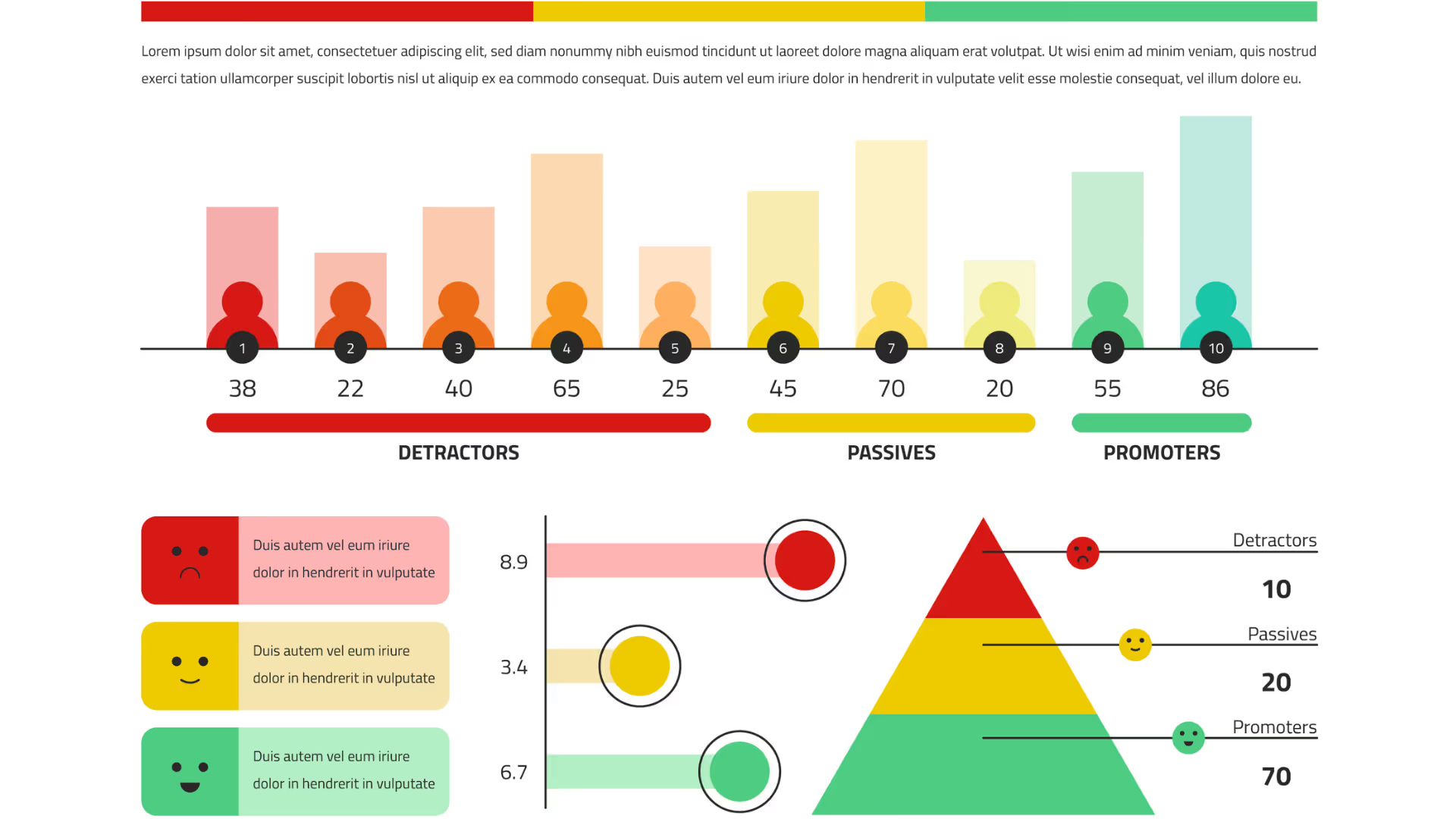
Respondents to the NPS question fall into three categories based on their score:
- Promoters (9–10): Loyal customers who will continue purchasing and refer others, actively driving growth.
- Passives (7–8): Satisfied but unenthusiastic customers who are vulnerable to competitive offerings.
- Detractors (0–6): Dissatisfied customers who can damage your brand through negative word-of-mouth.
The NPS is calculated by subtracting the percentage of Detractors from the percentage of Promoters, yielding a score between -100 and +100. A positive score means more Promoters than Detractors. The higher the number, the stronger the loyalty signal.
Uses in Market Research
1. Benchmark Performance
Organizations use NPS to compare their scores against industry benchmarks and competitors. This helps evaluate competitive positioning and identify whether your customer experience is above or below the norm for your sector.
2. Identify Improvement Areas
By pairing the NPS question with detailed follow-up questions, researchers can uncover specific areas where the customer experience falls short. Detractor feedback is particularly valuable for pinpointing friction points and prioritizing improvements.
3. Track Customer Loyalty Over Time
Running NPS surveys at regular intervals creates a longitudinal view of customer sentiment. This allows teams to monitor the impact of product changes, service improvements, or market shifts on overall loyalty.
4. Drive Customer-Centric Strategies
NPS insights feed into decisions across the organization - from product development and marketing to customer support and operations. The goal is that every initiative is grounded in real feedback, not internal assumptions.
Criticisms of NPS
While NPS is widely adopted, it’s not without its critics. Here are some of the most common concerns:
- Simplicity vs. Depth: Reducing customer sentiment to a single question may overlook the nuanced insights that more comprehensive surveys can provide.
- Cultural Bias: The 0–10 scale is interpreted differently across cultures, which can lead to inconsistent results in global research programs.
- Limited Predictive Power: Some research suggests NPS doesn’t reliably predict growth or customer behavior, as it ignores broader market and competitive factors.
- Lack of Actionable Insights: The score itself tells you how customers feel, but without follow-up questions and deeper analysis, it doesn’t tell you why — or what to do about it.
New Developments in NPS
The criticisms haven't killed NPS - they've pushed it to improve. Here's where the methodology is heading:
1. Integration with Digital Platforms
Companies are embedding NPS surveys directly into apps, websites, and digital touchpoints to capture feedback at the moment of experience - rather than relying on delayed email surveys that catch people well after the moment has passed.
2. Advanced Analytics and AI
Machine learning and AI are being applied to NPS data to identify patterns, predict churn, and surface insights that manual analysis would miss. These tools can process thousands of open-ended responses in seconds, categorizing themes and sentiment at scale.
3. Personalized Follow-Ups
Automated systems now trigger follow-up actions based on NPS responses. A Detractor gets a personal outreach from a support manager. A Promoter gets an invite to a referral program. The right response, triggered by the score - without anyone manually routing it.
4. Open-Ended Questions
Businesses are increasingly pairing the standard NPS question with open-ended follow-ups, allowing customers to explain their ratings in their own words. This provides much deeper understanding of the drivers behind each score and makes the data far more actionable.
5. Expanded Use Cases
NPS is no longer limited to customer experience. Organizations are applying it internally to measure employee satisfaction (eNPS), offering a valuable perspective on organizational health, culture, and retention risk.
Conclusion
NPS has been criticised, debated, and declared dead several times over. It's still here. The reason isn't blind loyalty to a single metric - it's that, used properly and paired with qualitative follow-up, it remains one of the fastest ways to track whether your customer relationships are heading in the right direction. The score is a starting point. What you do with it is what matters.
Want to run NPS properly - with follow-up logic, AI analysis of open-ends, and real-time dashboards? That's built into Quali-Fi. Book a chat to see how it works.